How the Mandolin Became Part of Irish Traditional Music?
When listening to a lively traditional Irish music session today, the bright, rhythmic, driving sound of stringed instruments is often central to the experience. While the fiddle, uilleann pipes, and wooden flute have deep centuries-old histories in Ireland, other instruments arrived much later. The mandolin is a relatively modern addition to the session framework, yet it has carved out a permanent home. Understanding how this Italian-born instrument transformed into the modern Irish mandolin reveals a fascinating journey of musical adaptation, innovative musicianship, and structural synergy.
The Historical Roots of the Mandolin in Ireland
The mandolin family traces its lineage back to the European lute traditions of the Renaissance, developing into its recognizable form in Italy during the late seventeenth and eighteenth centuries. For generations, it remained primarily associated with classical ensembles and continental European folk traditions.
Its introduction to Ireland occurred quietly around the turn of the twentieth century. Early cylinder recordings from around 1905 reveal that hybrid variants like the banjo-mandolin (or “banjolin”) were occasionally played by traditional musicians in both Ireland and the diaspora. Furthermore, early twentieth-century tune collections sometimes listed the mandolin alongside the violin and flute as a suitable instrument for playing Irish airs and dance tunes. However, these early appearances were isolated. The true breakthrough did not occur until the middle of the twentieth century.
The 1960s Folk Revival and Key Pioneers
The landscape of Irish traditional music changed dramatically during the folk revival of the 1960s. During this era, young, experimental musicians began introducing external folk influences, exploring unique accompaniments, and bringing new instruments into the traditional fold.
Among the primary trailblazers was Andy Irvine. Initially inspired by American old-time and folk icon Woody Guthrie, Irvine picked up the mandolin and brought it into the Dublin folk scene. Alongside Johnny Moynihan and Joe Dolan, he formed Sweeney’s Men in 1966. This group pioneered a fresh, innovative approach to arranging traditional songs, frequently pairing the mandolin with the newly introduced bouzouki.
When Irvine later co-founded the legendary folk band Planxty in 1972 alongside Christy Moore, Dónal Lunny, and Liam O’Flynn, the mandolin was thrust directly into the international spotlight. The intricate counter-melodies and crisp rhythm created by the interplay of Irvine’s mandolin and Lunny’s bouzouki established a brand new template for traditional accompaniment. Concurrently, virtuosos like Mick Moloney were demonstrating that the instrument was fully capable of handling the rapid-fire articulation required for traditional jigs and reels.
Structural Similarities that Facilitated the Transition
The rapid adoption of the mandolin during the folk revival was not just a matter of musical fashion; it was heavily supported by the structural layout of the instrument itself. The traditional mandolin features eight strings arranged in four pairs, or courses, tuned exactly like a standard fiddle or Irish tenor banjo: G-D-A-E.
Because the fingerings are identical to the fiddle, musicians already well-versed in Irish traditional tunes could transition to the mandolin with exceptional ease. Fiddle players looking for a crisp, percussive alternative, or tenor banjo players seeking a sweeter, more resonant sound for intimate settings, found the mandolin to be an ideal companion.
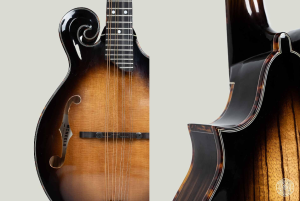
While flat-backed, oval-hole instruments are historically the most common choices for folk players, modern traditional musicians frequently explore various designs to achieve the ideal projection and tone. For example, an f-style mandolin distinguished by its beautiful florentine scroll work and violin-style f-holes—delivers a bright, punchy tone and strong note attack that allows a player to cut through the ambient noise of a busy pub session.
Frequently Asked Questions
What type of mandolin is best for Irish traditional music?
Musicians historically favored flat-backed or arch-top mandolins with oval sound holes because they provide a warm, woody tone with excellent sustain. However, players who need more volume and a sharp, percussive attack to be heard over louder instruments like the accordions or pipes often choose an f-hole style model.
Is the mandolin hard to learn for fiddle players?
Fiddle players generally find the transition remarkably straightforward because both instruments share the exact same G-D-A-E tuning and fret scale intervals. The primary adjustment lies in mastering plectrum execution (picking techniques) and managing string tension, rather than learning new finger patterns or chord shapes.
How does the mandolin differ from the Irish bouzouki?
Although they often play together in contemporary ensembles, the mandolin is the soprano member of the family, sounding a full octave higher than the Irish tenor banjo or octave mandolin. The bouzouki features a much longer neck and a deeper body, which provides a lower, more resonant harmonic resonance suitable for rhythmic backing.
Finding Your Perfect Instrument
Whether you are a seasoned multi-instrumentalist looking to add a new texture to your performance or a beginner stepping into the world of traditional folk music, choosing an instrument with clear tone and comfortable playability is vital.
The craftsmanship of a well-balanced instrument ensures that your jigs, reels, and hornpipes ring out with authentic acoustic warmth. To find the right fit for your musical style, you can explore the full range of high-quality models available at the McNeela All Mandolins Collection. For players who appreciate striking aesthetic design alongside robust volume and exceptional structural responsiveness, The McNeela Heritage F-Style Mandolin offers a fantastic balance of tradition and performance.