
Learn Your First Traditional Irish Reel in 4 Easy Steps
Are you ready to learn your first Irish reel and take your playing to the next level? No experience necessary!
There is a powerful trick to forming habits of which many of us are completely unaware.
This blog post is especially for beginners of traditional Irish music
I hope to help you get started and set up with the best music practice regime I know. A regime which will have you playing a simple traditional Irish reel within one month, with minimal effort.
Step 1 – Develop Your Motivation
First and foremost, I will assume you are motivated; you’ve got to want to do this!
I want you to surf the wave of your motivation, you know that moment when you’ve decided, “Right, I’m gonna do it! I’m finally going to learn how to play traditional Irish music!”.
That’s the moment to read this post and the moment when you’re ready to commit; the energy is there, you’re open to advice, happy to plan and momentum from that energy will propel you along.
This is also a great moment to get a traditional Irish music teacher should you wish.
Thanks to the miracle of modern technology, you can get plenty of brilliant traditional Irish tutors online, no matter where you are in the world, so lack of local availability need not be an obstacle.
Don’t worry, you don’t have to have a teacher initially, there are plenty of online resources to get you up and going before formal tuition is needed.
Step 2 – Set Your Goals
This is a tricky bit, but it doesn’t have to be.
Often when we fail in acquiring a new skill (like learning a new instrument), it’s caused by the goals we set for ourselves.
Like the desire to start playing a tune immediately, or thinking we should be able to play the D scale after only hearing it twice!
These kinds of goals early on are nearly guaranteed to cause frustration and eventually lead to you putting away your instrument and never touching it again.
Does this sound familiar? If so, you might need to slow things down and make more realistic goals for yourself. Lots of small achievements over time build up and gain momentum, leading to bigger achievements.
Start Small
If you’re struggling to make any noticeable progress, take a mental step back and start looking at goal-setting again.
The trick? Start small. Both those words are critical:
“Start” – don’t talk about it, or daydream about it, just start.
“Small” – make your goals bite-sized, even five minutes a day is better than none.
I’m going to use an Anglo concertina as an example, it’s one of my best-selling types of instruments.
So, let’s say you have a concertina, but you’ve never played a musical instrument before or you’ve never played this style of instrument before, where do you start?
Step 3 – Build a Practice Habit
Aim to practice for no more than ten minutes a day. With a concertina, note placement is crucial, as is your push/pull technique.
Remember to keep your goals bite sized – for example, you could print out a concertina fingering diagram and commit to learning off where each note is on one side of the concertina.
How simple is this? You don’t even need a concertina. In fact, only a certain amount of buttons are used on each side of the concertina for most traditional Irish music so you don’t even have to learn note placement on all 30 buttons.
The following week could be spent learning the other side. Baby steps!
Remember!
If the idea of ten minutes is daunting, switch to five minutes a day – the crucial takeaway here is that you commit to doing something nearly every day.
If you have a tutor they will help you set realistic goals and give you handy starting points for learning your particular traditional Irish instrument.
Practice Cues
- Add a daily alert to your phone or write a note on your calendar to remind you to practice.
- Make sure the instrument is within easy reach and you have a space to practice.
- Make the instrument part of your decor, most traditional Irish instruments are blessed with aesthetic appeal so put them in pride of place in a room you frequent.
If it’s a concertina, have it nearby, on top of its hard case, or on a sideboard, ready to pick up, and have a stool or upright chair ready to sit into before you begin.
If it’s a bodhrán hang it on your wall or invest in a handy instrument stand. Your options are as varied as your creativity is.
Back in the 19th century and early 20th century in Ireland, concertinas were stored in a special nook in the chimney, ready to be played by a member of the household or a visitor – the modern entertainment equivalent of a stereo system or TV.
A Reward System
To instill a daily habit, you need a cue and a reward.
Cue
The cue is the alert on your phone or note on your calendar.
Reward
The reward is a pleasurable gain from the activity itself. So, if you treat yourself to a reward after your practice you’re more likely to associate the practice with pleasure.
The reward doesn’t have to be complicated or big, it just needs to feel nice.
After your concertina practice you could promise yourself a delicious hot drink – a cup of coffee, tea or a flavoursome herbal decoction, alternatively you could listen to your favourite Irish session tune or favourite traditional Irish musician, or how about a chocolate biscuit, a small slice of cake etc.?
It just needs to put a smile on your face and reward you for your actions.
Of course, that great feeling you get upon conquering a tricky piece of fingering, or finally completing a musical scale by heart will also further enshrine your practice in the pleasure centres of the brain but in the meantime, reward yourself.
Step 4 – Your First Traditional Irish Reel
Once you’ve set up your daily practice habit allow yourself two breaks in a seven day week.
The muscles you’re using will start to memorise placement and as you progress your brain will start to accumulate musical knowledge. As a nice side effect you will actually start to regenerate parts of the brain!
Soon you’ll be ready to tackle your first tune.
It can be something as simple as Twinkle Twinkle Little Star.
If you feel you’re ready for something a little more challenging however, take a look at this extremely popular easy beginner traditional Irish reel, Kitty’s Gone a Milking.
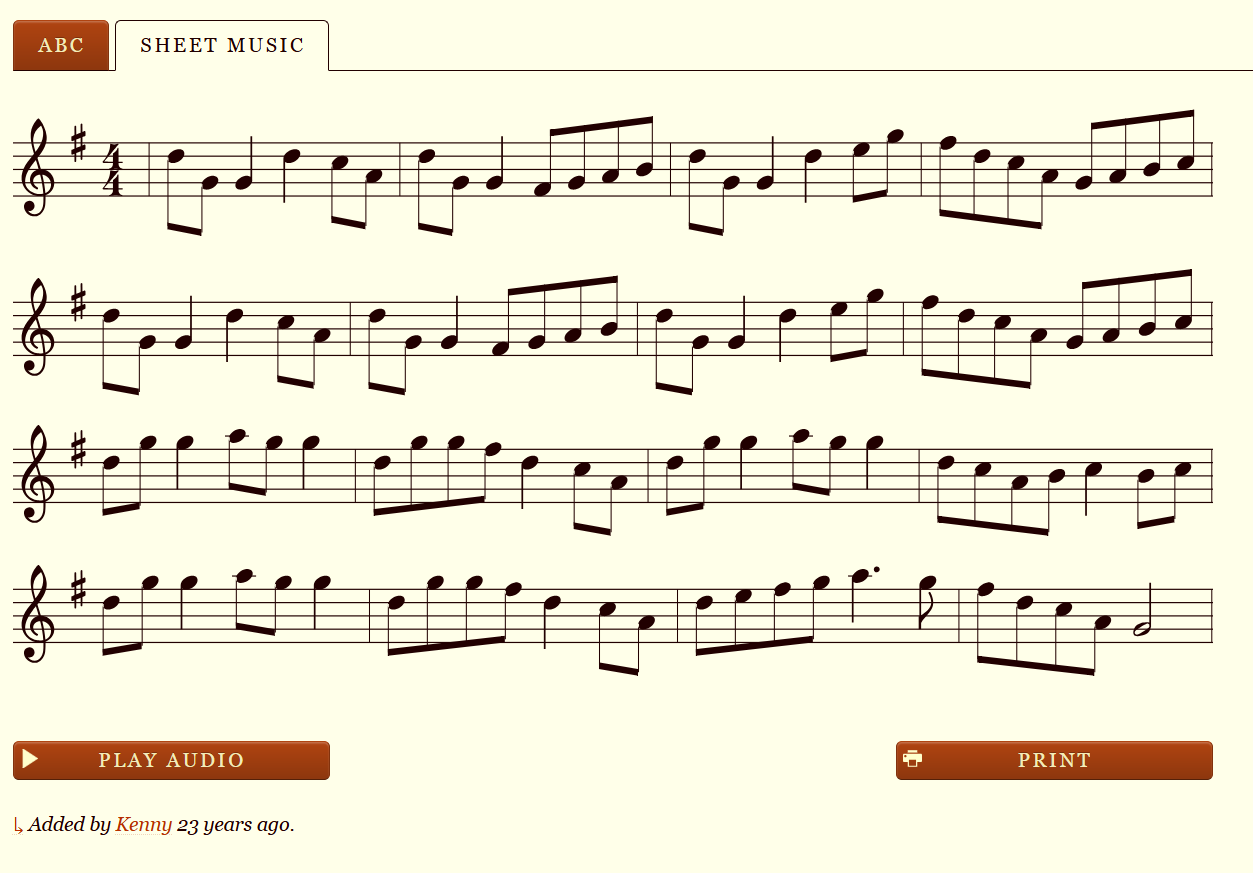
You can slow it down, break it into bite sized practice pieces and take it at your own pace.
Remember, most traditional Irish music learning is done by ear and this is something you’ll need to get used to, particularly if you come from a classical music background.
I’ve added ABC notation to the above video to help you along. The notes in capitals are on the lower scale and the small letters are on the higher, a 2 directly after the note denotes holding that note for two beats.
You’ll note from the recording that Caitlín is adding decorative notes; you can ignore those for now and focus on the bare bones of the tune, learning them off by heart.
Five sessions of practice will have you up and running and playing a simple Irish reel. Now, how easy was that?
Access Expert Advice for Learning Traditional Irish Music
We have a collection of inspirational yet very practical guest blog posts on how best to approach learning traditional Irish music by top Irish musicians, Caitlín Nic Gabhann, Liam O’Connor and Conal Ó Gráda.
Online Traditional Irish Music Lessons
Thinking of learning Irish music but not ready to invest in an instrument just yet? No problem.
At McNeela Music, you can start your musical journey today with our growing selection of online traditional Irish music masterclasses without needing an instrument in hand. Now you can learn from a wide range of some of the best traditional Irish musicians in the world!
Each course is taught by a leading figure in Irish traditional music and includes step-by-step video lessons, insights into Irish music tradition, and practical tools to help you build skill and confidence.
We’re constantly expanding our library of lessons. You can now explore:
- Our Button Accordion Masterclass with Benny McCarthy
- Our Bodhrán Masterclass with Rónán O’Snódaigh
- Our Concertina Masterclass with Jack Talty
- Our Ultimate Flute Masterclass with Tom Doorley
- Our Tin Whistle Masterclass with John O’Brien
And there’s more coming soon. We’ve got more courses that are currently in production with more instruments and tutors to follow.
We’ll be adding even more instruments and lesson content in the coming months, so be sure to subscribe to our newsletter to stay updated on new releases, special offers, and exclusive content for learners.




Share your thoughts
Okay … this sounds doable.. A question …is it possible to slow down the tune you have here? I play violin, viola etc. I’d like to hear it at slow pace so I can learn incrementally? I have not been able to play the style … and the bowing… as you know is so different. Thank you
Hi Darby. If you click on the 3 buttons on the bottom right of the video you should see a video playback speed option. This will allow you to slow it down.
thanks for the advice. I just recently decided to start playing again. Your advice came at a optune time. Thank you.
Any tips on memorizing ? I struggle greatly with this
Yes! Hi Frank, please go to my next blog post here: https://blog.mcneelamusic.com/top-tips-for-trad-musicians-how-to-memorise-music/?utm_source=ActiveCampaign&utm_medium=email&utm_content=how+do+I+memorise+all+these+tunes%3F%21&utm_campaign=Value+Email+-+Memorising
If you like a tune, listen to it several times until the melody is in your head, then try playing it by ear. If you can read music, I’d suggest you still have a go by ear before turning to the dots. Once you have got the basic melody, concentrate on the bars that are giving you the most trouble. Then wean yourself off the dots ie have the sheet music in front of you but try to avoid looking at it as much as you can.
Hi I play a low D whistle as I don’t read sheet music ive by learned by tabs I love the slow airs could u recommend the best way to learn by ear
Grand ! I look forward to the 5 tunes a week ,print them in landscape so I can follow the notes and do as you say in small manageable parts till it all comes together. I.ve never played an instrument in 67 years till now, Thank -you Paraic , Mark in australia
Lovely, just what's needed. Thank you
Good on you Mark. I started on the concertina at 70, just a year ago, as a retirement 'lark'. While I now deeply regret not starting earlier, it has been a joy so far. Paraic's five tune friday is a great idea. You'll love it. Good luck and best wishes. Arthur, also in Australia.